
For India, the guiding principle should remain clear: Engage Bangladesh as a sovereign nation and society rather than through the prism of any individual leader or political party, suggests Manoj Mohanka.

As many as 274 fugitives have been repatriated from 36 countries in the last 7 years, an average of around 40 per year and a 10-fold jump from the 2004-13 period when around four fugitives were brought back every year, the government said on Tuesday.

European Commission President Ursula von der Leyen wore stunning Banarasi during her India visit. See how fashion became smart diplomacy.

Prime Minister Narendra Modi and Indonesian President Prabowo Subianto have significantly advanced the India-Indonesia Comprehensive Strategic Partnership, securing crucial agreements on defence, critical minerals, and maritime security, including BrahMos missile supply and Sabang port development.

India has lodged a 'strong protest' with Iran over recent strikes on commercial vessels in the Strait of Hormuz, which resulted in the death of one Indian sailor and injuries to several others, calling for an immediate cessation of hostilities and a return to diplomatic engagement.

Foreign Secretary Vikram Misri stated that the Indian government has no involvement or official support for Track 2 discussions on India-Pakistan ties, even when retired Indian officials participate. He clarified that such participants speak in their personal capacities and do not represent the government's views, and New Delhi does not take cognisance of these private events.
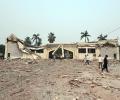
Former Chief of Defence Staff Gen Anil Chauhan (retd) revealed that Prime Minister Narendra Modi directed an 'unthinkable' and 'big lesson' action against Pakistan following the April 2024 Pahalgam terror attack, emphasising India's zero-tolerance policy for cross-border terrorism and the need for irrefutable evidence.
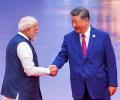
India's dual pursuit of a robust strategic partnership with Washington and a pragmatic, tension-management policy with Beijing represents the essence of modern multi-alignment. By embracing economic pragmatism, learning to compartmentalize political differences, and engaging in continuous dialogue, India can secure its borders, grow its economy, and contribute to a stable, multipolar Asian century, points out Ambassador Rajasekhar.

The Centre for Studies of International Relations (CSIR) has established the International Centre for Civilizational Studies "Manas and Mahabharata" in Bishkek, Kyrgyzstan, in collaboration with the Manas National Academy. The inauguration also saw the release of the first Hindi translation of the Kyrgyz epic "Manas," aiming to foster scientific, educational, and cultural cooperation between India and Kyrgyzstan.
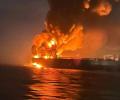
India's foreign policy establishment is adjusting with alacrity in real time -- an extraordinary spectacle in itself, considering the manifest reluctance to indulge in public diplomacy critical of American moves, observes Ambassador M K Bhadrakumar.

Pakistan Prime Minister Shehbaz Sharif expressed 'forever grateful' to US President Donald Trump for his 'timely' intervention in securing a ceasefire with India following a military conflict last year, a claim India has consistently rejected.

External Affairs Minister S Jaishankar met his Chinese counterpart Wang Yi in Manila, reiterating that peace and tranquillity in border areas are prerequisites for normal India-China relations. He stressed the importance of mutual respect, interest, and sensitivity, while also raising concerns about market access, trade imbalance, and supply chain uncertainties.

India has voiced deep concern over a drone attack targeting the Barakah nuclear facility in the United Arab Emirates (UAE), calling it a dangerous escalation in the West Asia conflict.

It is an unusual choice to depute a retired general for the funeral of a revered religious figure but a thoughtful one in an attempt to inject verve into the bilateral relationship and restore the equilibrium in India's West Asian policies, notes Ambassador M K Bhadrakumar.

US Vice-President J D Vance's unexpected phone call to Prime Minister Narendra Modi on August 8 has ignited speculation about a potential diplomatic overture, possibly seeking India's support amidst the escalating US-Iran conflict and a shifting global power landscape, suggests Ambassador M K Bhadrakumar.

The Indian embassy in Ukraine is actively monitoring the critical situation of 13 Indian seafarers aboard MV AMIR1, who are reportedly under threat from drone and missile attacks near Ukraine's Black Sea coast.

To get its act going in Myanmar, India would need very dynamic diplomacy and not the lazy all-eggs-in-one-basket approach, points out Subir Bhaumik.

India has strongly protested to the United States after three merchant ships with Indian crew members were attacked by the American military off the coast of Oman, resulting in the deaths of three Indian nationals.
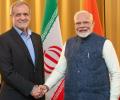
Prime Minister Narendra Modi held a telephonic conversation with Iranian President Masoud Pezeshkian, discussing recent developments in West Asia and reiterating India's emphasis on the importance of freedom of navigation in the Strait of Hormuz. Modi welcomed the recent peace understanding between the US and Iran, stressing dialogue and diplomacy for regional stability. India will also send representatives to the burial ceremonies of Iran's late Supreme Leader.

US President Donald Trump has lauded India as an 'essential partner' and 'trusted ally' in addressing regional challenges, particularly its 'big role' in West Asia peace efforts, following discussions with Prime Minister Narendra Modi at the G7 Summit.

India has expressed firm opposition to attacks on merchant shipping amidst the ongoing Iran conflict, revealing that several Indian nationals have died or are missing due to these incidents. The nation also called for restraint, de-escalation, and prioritising civilian safety in the region.

The boundary mess between India and Nepal needs a solution in a manner as mentioned by Nepal's Foreign Minister Shishir Khanal: 'On evidence not emotions', counsels Lieutenant General Shakti Gurung (retd).

India has welcomed the ceasefire between the US and Iran, advocating for de-escalation, dialogue, and diplomacy to secure lasting peace in West Asia.

US President Donald Trump lauded Prime Minister Narendra Modi's 'calm, cool, killer' persona at the G7 leaders' lunch in France, underscoring the deeply strategic relationship and formidable diplomatic skills of the Indian leader ahead of their crucial bilateral meeting.

India has condemned an attack on a Cyprus-flagged commercial vessel off the coast of Oman, which resulted in one Indian crew member going missing. The incident occurred amidst escalating hostilities between Iran and the US in West Asia, prompting India to call for immediate de-escalation and an end to targeting commercial shipping in the region.

Prime Minister Narendra Modi has called for the resolution of the West Asia crisis and the Ukraine conflict through dialogue and diplomacy, asserting that military action alone cannot achieve lasting peace. He made the remarks after talks with Norwegian Prime Minister Jonas Gahr Store.

India has firmly rejected Nepal's objection to the upcoming Kailash Mansarovar Yatra via the Lipulekh Pass in Uttarakhand, dismissing Kathmandu's territorial claims over the region.

Taking to Truth Social on Monday evening, Trump reposted Gor's original Sunday night dispatch alongside a video snippet from the grand celebrations marking the 250th anniversary of America's independence, hosted at the iconic Bharat Mandapam in the national capital.

We who were dreaming of being the third largest economy in dollar terms, have slid back to sixth, thanks to the falling rupee. We are moving about with begging bowls for investments and trade opportunities, which will be a while in materialising, if ever, notes Shreekant Sambrani.

Trump has played throughout his career as a deal-maker who could deliver where others could not, and Ukraine represents the ultimate test of that image, notes Manish Dabhade.

India has expressed strong concerns over attacks on commercial ships in the Strait of Hormuz, citing its importance to India's energy and economic security. Ambassador Yojna Patel highlighted the need to respect international law and ensure the safety of seafarers, while also addressing broader Middle East issues including the situation in Gaza and Lebanon.

India and Australia have signed significant agreements covering civil nuclear energy, maritime security, and critical minerals, reinforcing their partnership's role in ensuring a peaceful Indo-Pacific. The pacts facilitate uranium supply from Australia to India and enhance cooperation in defence, cyber, and critical technologies.

Addressing the 36th extraordinary session of the Council of the International Maritime Organisation (IMO) held on Thursday in London, the Indian envoy said, "India remains deeply concerned about the evolving situation and continues to call for de-escalation through dialogue and diplomacy, with utmost restraint and priority being given to the safety of civilians."

'Nepal today is far more aware, self-confident, aspirational, and assertive.' 'India's policy so far has not been geared to this shift. It is time to redraw our Nepal strategy.'

Modi's comments on underlining the importance of ensuring the safety of seafarers came against the backdrop of growing anger in India over the killing of the three Indian crew members in a US military attack on a merchant ship off the coast of Oman last week.
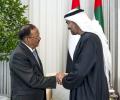
India is the only significant power that all parties trust, or at least do not distrust, notes former defence secretary Ajay Kumar.
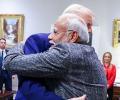
One must wonder whether Mr Modi's efforts to wine and dine the Big Two of today's world were seen as a sign of weakness rather than a proffered arm of friendship, points out R Jagannathan.
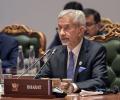
India has expressed serious concerns about the West Asia crisis and its potential impact on energy supplies and maritime stability, urging BRICS nations to find practical solutions to geopolitical challenges and unilateral sanctions.

The Congress party has called on the BJP-led government to adopt a unified national approach to restore India's role as a voice for peace, criticising the government's foreign policy and its impact on India's global standing.

India would confront a more entrenched China, a less dependable United States, and a regional order increasingly shaped by great-power bargaining over which it exercises limited influence, notes Amberish K Diwanji.
